Thursday, June 06, 2013

What does the protest wave in Turkey mean?

I doubt that anyone knows for sure yet, and any comprehensive answer to that question would have to be complicated as well as tentative.  There are also different ways to frame the question itself.  Here is how Kerem Oktem poses it:
Hundreds of thousands of protesters in the streets of Istanbul. Tens of thousands of policemen attacking with teargas bombs and rubber-bullets. The Bosphorus bridge heaving with demonstrators. Solidarity meetings all over Turkey and beyond. A government that seems to have lost touch with events on the ground. An establishment media whose patrons have been bullied not to report what is in front of its eyes. A nation in turmoil. A prime minister, who in 2011 was lecturing Hosni Mubarak about democracy and divine justice - and who was re-elected then with a massive popular vote - who now looks awkwardly like the former Egyptian dictator. All this has thrown Turkey into its deepest crisis for more than a generation.

Turkey seems among the unlikeliest candidates for a popular uprising. It has one of Europe's few thriving economies, with record growth, falling unemployment and decreasing urban poverty. The country’s technical infrastructure was never as advanced, its people never as educated, its society never as broadly middle class as it is now. A peace process in Kurdistan promises a new deal with the country’s largest and most brutally oppressed minority after decades of war. The socio-economic factors which drove people in Egypt, Tunisia, Greece and Bulgaria to the streets are largely absent. Despite all this, a small protest in the Gezi Park of Istanbul’s Taksim Square quickly turned into an enormous eruption of protest.

So why Turkey, and why now?
I think Oktem's piece does a good job of analyzing some key dimensions of the background to the current protest wave, which he puts together this way:
What, beyond their immediate spark, has motivated the protests? At least three interrelated factors have incubated them:

* an increasingly uninhibited neoliberal development process
* the government's growing conservative zeal
* a troubled foreign policy

These three factors come together in a further overarching source of discontent: with the prime minister’s authoritarian style of government.
(The term "neoliberal" is not quite right here, a bit closer to sloganeering than analysis, and the term "conservative" is a bit too vague and euphemistic in this context, but OK.)  That last, overarching, factor is the main focus of the piece below, by Steven Cook & Michael Koplow. Their assessment overlaps with Oktem's to a considerable degree, though with some differences of emphases and terminology, so the two pieces are worth reading in tandem. They agree that the repercussions of these protests, and the forms that they take, may prove crucial to the future of Turkish democracy.

=>  On the way there, however, let me toss out some random musings and impressions of my own. As long as I'm indulging in speculative comparisons between politics in Turkey and in other places (as I did a few days ago), I'll add another one. I must confess that watching the eruption of mass protests in cities across Turkey, calling forth a baffled and excessively violent response from the authorities, brings back reminders of 1968.

In 1968 and the years that followed, localized protests about various specific issues (including a so-called People's Park in Berkeley in 1969) swelled into mass demonstrations that expressed a wide and complex range of grievances and aspirations, along with a generalized spirit of revolt against The System.  As in Turkey today, 1968 erupted during a period of sustained economic growth and increasingly broad-based prosperity in western societies.  (And during a period, incidentally, when most western societies were governed by what looked like stable political regimes of democratic representative government.  Some might be inclined to take that for granted, but from a long-term historical perspective, that was an unusual, almost astonishing, situation.  It was also in sharp contrast to the situation in a country like Czechoslovakia, which had its own, very different, Prague Spring in 1968.)  As in Turkey today, students and university-educated young people were in the forefront of the protests, though they were far from the only ones who felt angry and dissatisfied—and in France, to everyone's astonishment, student protests in Paris triggered a nation-wide general strike.

The spirit of '68 continued to inspire various social movements and cultural tendencies for decades, for good and for ill (two of its most broadly positive tributaries flowed, for example, into second-wave feminism and the gay rights movement).  But in the US it also provoked a major cultural and political backlash that, among other things, helped produce an almost unbroken string of Republican presidents from 1969 through 1992 and continued to shape American politics through the end of the century and even beyond. (Prime Minister Erdogan was clearly trying to threaten his opponents with that sort of backlash when he warned them that "if you gather 100,000 people, I can gather a million."  He might even be right about that, by the way.)

Obviously, one wouldn't want to push those parallels too far.  In many respects Turkey in 2013 is a very different society from the US or France or Britain or West Germany in 1968, and the overall historical moment is very different, too.  Also, I don't get the impression that the aims of the current protest wave in Turkey include the kinds of utopian aspirations that helped give the spirit of '68 its distinctive resonance.  And so on.

Nevertheless, I do think there are ways in which reflecting on Turkey's current protests in light of 1968 can offer useful food for thought.  One lesson is that when massive protest waves seem to appear out of nowhere, making sense of them requires looking for deeper forces under the surface of events. Another is that massive protest movements often derive much of their energy from important grievances and concerns that are not being effectively addressed, or even clearly articulated, by the 'official' processes of electoral and party politics—which happens to be the case in Turkey today.  And when we try to anticipate the likely prospects, dynamics, and repercussions of this protest wave, we should expect to be surprised.

=>  A final remark on the pieces by Oktem and by Cook & Koplow. Both analyses are quite critical of Erdogan and, more generally, of some directions in which Erdogan and the AK Party have been taking Turkey—Cook & Koplow go so far as to describe "Turkey under the AKP" as "the textbook case of a hollow democracy"—but both wind up offering assessments that can be seen as guardedly optimistic, or at least not pessimistic. They regard this protest wave as a justified and valuable reaction against harmful and dangerous developments over the past decade of AK rule. But they also seem to regard the most dangerous tendencies as potentially reformable, and they hope (and half-predict) that this shock will wind up having positive results for genuine democratization in Turkey.

Here is Oktem's summing-up:
Turkey is still a democracy and this protest is not about regime change. It is an explosion of discontent with a leader who has done a lot of good for the country, but who has become arrogant, out of touch, shielded from society by second-rank advisers, and unable to listen to anyone who disagrees with him. Erdoğan’s charisma is now significantly damaged and his chances of becoming Turkey’s president are diminished.

If President Gül and the more independently minded members of the government show that they take the protesters, and the "other 50%" of Turkey's population seriously, then the protests that began ın Taksim Square will enter the annals of Turkey’s history of the struggle for democracy and human rights.  [....]

The stakes are high. But there is now also a prospect for a better, more inclusive democracy in Turkey.
It strikes me, frankly, that this analysis localizes the problem too specifically in one individual, Erdogan. Cook & Koplow are even more tentative in their prognosis, though they hope the AK Party learns the right lessons from this episode:
The combination of a feckless opposition and the AKP's heavyhanded tactics have finally come to a head. This episode will not bring down the government, but it will reset Turkish politics in a new direction; the question is whether the AKP will learn some important lessons from the people amassing in the streets or continue to double down on the theory that elections confer upon the government the right to do anything it pleases.
Well, we'll see.

Yours for democracy & political liberty,
Jeff Weintraub

==============================
Foreign Policy
How Democratic Is Turkey?
Not as democratic as Washington thinks it is.
June 3, 2013
By Steven A. Cook & Michael Koplow

It seems strange that the biggest challenge to Turkish Prime Minister Recep Tayyip Erdogan's authority during more than a decade in power would begin as a small environmental rally, but as thousands of Turks pour into the streets in cities across Turkey, it is clear that something much larger than the destruction of trees in Istanbul's Gezi Park -- an underwhelming patch of green space close to Taksim Square -- is driving the unrest.

The Gezi protests, which have been marked by incredible scenes of demonstrators shouting for Erdogan and the government to resign as Turkish police respond with tear gas and truncheons, are the culmination of growing popular discontent over the recent direction of Turkish politics. The actual issue at hand is the tearing down of a park that is not more than six square blocks so that the government can replace it with a shopping mall but the whole affair represents the way in which the ruling Justice and Development Party (AKP) has slowly strangled all opposition while making sure to remain within democratic lines. Turkey under the AKP has become the textbook case of a hollow democracy.

The ferocity of the protests and police response in Istanbul's Gezi Park is no doubt a surprise to many in Washington. Turkey, that "excellent model" or "model partner," is also, as many put it, "more democratic than it was a decade ago." There is a certain amount of truth to these assertions, though the latter, which is repeated ad nauseum, misrepresents the complex and often contradictory political processes underway in Turkey. Under the AKP and the charismatic Erdogan, unprecedented numbers of Turks have become politically mobilized and prosperous -- the Turkish economy tripled in size from 2002 to 2011, and 87 percent of Turks voted in the most recent parliamentary elections, compared with 79 percent in the 2002 election that brought the AKP to power. Yet this mobilization has not come with a concomitant ability to contest politics. In fact, the opposite is the case, paving the way for the AKP to cement its hold on power and turn Turkey into a single-party state. The irony is that the AKP was building an illiberal system just as Washington was holding up Turkey as a model for the post-uprising states of the Arab world.

The new political, cultural, and economic openness helped Erdogan ride a coalition of pious Muslims, Kurds, cosmopolitan elites, big business, and average Turks to re-election with 47 percent of the popular vote in the summer of 2007, the first time any party had gotten more than 45 percent of the vote since 1983. This was unprecedented in Turkish politics. Yet Erdogan was not done. In 2011, the prime minister reinforced his political mystique with 49.95 percent of the popular vote.

Turkey, it seemed, had arrived. By 2012, Erdogan presided over the 17th-largest economy in the world, had become an influential actor in the Middle East, and the Turkish prime minister was a trusted interlocutor with none other than the president of the United States. Yet even as the AKP was winning elections at home and plaudits from abroad, an authoritarian turn was underway. In 2007, the party seized upon a plot in which elements of Turkey's so-called deep state -- military officers, intelligence operatives, and criminal underworld -- sought to overthrow the government and used it to silence its critics. Since then, Turkey has become a country where journalists are routinely jailed on questionable grounds, the machinery of the state has been used against private business concerns because their owners disagree with the government, and freedom of expression in all its forms is under pressure.

Spokesmen and apologists for the AKP offer a variety of explanations for these deficiencies, from "it's the law" and the "context is missing," to "it's purely fabricated." These excuses falter under scrutiny and reveal the AKP's simplistic view of democracy. They also look and sound much like the self-serving justifications that deposed Arab potentates once used to narrow the political field and institutionalize the power of their parties and families. Yet somehow, Washington's foreign-policy elite saw Turkey as a "model" or the appropriate partner to forge a soft-landing in Egypt, Tunisia, Libya and elsewhere.

In the midst of the endless volley of teargas against protesters in Taksim, one of the prime ministers advisors plaintively asked, "How can a government that received almost 50 percent of the vote be authoritarian?" This perfectly captures the more recent dynamic of Erdogan's Turkey, where the government uses its growing margins of victory in elections to justify all sorts of actions that run up against large reservoirs of opposition.

The most obvious way this pattern has manifested itself is in the debate over the new Turkish constitution, which Erdogan had been determined to use as a vehicle to institute a presidential system in which he would serve as Turkey's first newly empowered president. When the opposition parties voiced their fervent opposition to such a plan and the constitutional commission deadlocked in late 2012 -- missing its deadline of the end of the year to submit its recommendations -- Erdogan threatened to disregard the commission entirely and ram through his own constitutional plan. He floated the idea again in early April 2013, but softened his position as it became clear that there is significant opposition to his presidential vision even within the AKP.

Turkey's new alcohol law, which among other things sets restrictions on alcohol sales after 10 p.m., curtails advertising, and bans new liquor licenses from establishments near mosques and schools, is another example of the AKP's majoritarian turn. Despite vociferous opposition, the law was written, debated, and passed in just two weeks, and Erdogan's response to the law's critics has been to assert that they should just drink at home.

Similarly, the AKP is undertaking massive construction projects in Istanbul, including the renovation of Taksim Square, the building of a new airport, and the construction of a third bridge over the Bosphorus, all of which are controversial and opposed by widespread coalitions of diverse interests. Yet in every case, the government has run roughshod over the projects' opponents in a dismissive manner, asserting that anyone who does not like what is taking place should remember how popular the AKP has been when elections roll around. In a typical attempt to use the AKP's vote margins as a  cudgel,Erdogan on Saturday warned the CHP -- Turkey's main opposition party -- "if you gather 100,000 people, I can gather a million."

Turkey's anti-democratic turn has all taken place without much notice from the outside world. It was not just coercive measures -- arrests, investigations, tax fines, and imprisonments -- that Washington willfully overlooked in favor of a sunnier narrative about the "Turkish miracle." Perhaps it is not as clear, but over the last decade the AKP has built an informal, powerful, coalition of party-affiliated businessmen and media outlets whose livelihoods depend on the political order that Erdogan is constructing. Those who resist do so at their own risk.

All this is why the current tumult over the "redevelopment" of Gezi Park runs deeper than merely the bulldozing of green space. It represents outrage over crony capitalism, arrogance of power, and the opacity of the AKP machine. In the media, Erdogan has encouraged changes in ownership or intimidated others to ensure positive coverage -- or, in the case of the Gezi Park protests, no coverage. In what was a surreal scene - but sadly one that was altogether unsurprising to close observers of Turkey -- CNN International on Friday was covering the protests live in Taksim while at the very same time CNN Turk, the network's Turkish-language affiliate, was running a cooking show as the historic heart of Turkey's largest city was in enormous upheaval. This dynamic of Turkish press censorship and intimidation, in which media outlets critical of the government are targeted for reprisal, has resulted in the dismissal of talented journalists like Amberin Zaman, Hasan Cemal, and Ahmet Altan for criticizing the government or defying its dictates. This type of implicit government intimidation is unreasonable in an allegedly democratic or democratizing society.

Under these circumstances, Turkish politics is not necessarily more open than it was a decade ago, when the AKP was pursuing democratic reforms in order to meet the European Union's requirements for membership negotiations. It is just closed in an entirely different way. Turkey has essentially become a one-party state. In this the AKP has received help from Turkey's insipid opposition, which wallows in Turkey's lost insularity and mourns the passing of the hard-line Kemalist elite that had no particular commitment to democracy. Successful democracies provide their citizens with ways in which to express their desires and frustrations beyond periodic elections, and Turkey has failed spectacularly in this regard.

The combination of a feckless opposition and the AKP's heavyhanded tactics have finally come to a head. This episode will not bring down the government, but it will reset Turkish politics in a new direction; the question is whether the AKP will learn some important lessons from the people amassing in the streets or continue to double down on the theory that elections confer upon the government the right to do anything it pleases.

It is not just the AKP that needs to reassess its policies, but Washington as well. Perhaps the Obama administration does not care about Turkey's reversion or has deemed it better to counsel, cajole, and encourage Erdogan privately and through quiet acts of defiance like extending the term of Amb. Francis Ricciardone, who has gotten under the government's skin over press freedom, for another year.

This long game has not worked. It is time the White House realized that Erdogan's rhetoric on democracy has far outstripped reality. Turkey has less to offer the Arab world than the Obama administration appears to think, and rather than just urging Arab governments to pay attention to the demands of their citizens, Washington might want to urge its friends in Ankara to do the same as well. The AKP and Prime Minister Erdogan might have been elected with an increasing share of the popular vote over the last decade, but the government's actions increasingly make it seem as if Turkish democracy does not extend farther than the voting booth.

Tuesday, June 03, 2008

A Democratic primary fight like no other (New York Times)

Actually, the Democratic nomination fight isn't quite over yet, but that moment is approaching. And whatever else one might think about it, it has certainly been a hell of a drama. (And we're still 5 months away from the general election in November!)

John Harwood lays out the overall picture in Monday's New York Times. Some highlights:
The first black and first woman with solid chances to win the White House have nearly split the Democratic Party, with his coalition of young voters, affluent liberals and blacks against her coalition of women, older voters, Hispanics and working-class whites. Mr. Obama appears on track to a narrow nomination victory if he can win over just a small fraction of the roughly 200 superdelegates who remain undecided.

But that numbing familiarity cannot obscure what makes this nomination fight singular. In its cost, duration, competitiveness and breadth of citizen involvement, it stands alone in the history of American presidential politics.

“We’ve had higher rates of participation, not just by voting but by volunteering and giving, than any other,” said Michael J. Malbin, executive director of the Campaign Finance Institute and a onetime Congressional aide to Dick Cheney when he was a congressman. “And there’s nothing that’s remotely close.” [....]

Shattering records, the two leading Democrats raised nearly $500 million through April to finance their rival armies. [....]

Moreover, each top Democrat has proven resilient enough to defy the normal laws of political gravity. In nominating fights over the last two decades, such formidable challengers as Bob Dole, Richard A. Gephardt, John McCain, Bill Bradley and Howard Dean have faded after early defeats the way John Edwards, Mitt Romney and Rudolph W. Giuliani did this year.

But Mrs. Clinton has finished robustly despite a costly string of February losses. Even after this weekend’s disappointment of failing to gain all the Michigan and Florida delegates she had sought before the Rules and Bylaws Committee of the Democratic Party, Mrs. Clinton commands 45 percent of convention delegates to Mr. Obama’s 49 percent.

Just as remarkable, the intensity of competition has been inversely proportional to the ideological stakes. [....] Above all, their contest has pitted different styles of leadership toward highly similar policy ends.
Democratic turnout has been massive and, again, unprecedented.
The more than 17 million popular votes Mr. Obama has received exceed the total for Mr. Kennedy and Mr. Carter combined in 1980.
We have been hearing, and will continue to hear, angry arguments about the right way to calculate overall popular-vote totals for this year's Democratic contest. (The Democratic nominating system is such a complicated mess that there is no straightforward or definitive answer.) Here are some alternative calculations, using different criteria, from Real Clear Politics. Some put Obama ahead, some put Clinton ahead--but note that all of them put the difference between the two candidates at less than 1% of the total. The basic reality is that, in the end, Obama and Clinton fought each other pretty much to a draw.
By counting the disputed primary results from Michigan and Florida, Mrs. Clinton insists she has collected even more popular votes. In her against-the-odds attempt to win over enough superdelegates for the nomination, she cites victories over Mr. Obama in significant states like California, New York, New Jersey, Ohio, West Virginia, Pennsylvania and New Hampshire.

Even if that argument gives pragmatic Democrats pause, here is where they can find consolation and Republicans angst. In each of those states, Mr. Obama received more votes in losing the Democratic primary than Mr. McCain did in winning the Republican contest.
And it's not (quite) over yet.

--Jeff Weintraub
=========================
New York Times
June 2, 2008
THE CAUCUS
Democratic Primary Fight Is Like No Other, Ever
By John Harwood

The 2008 Democratic primary battle between Senators Barack Obama and Hillary Rodham Clinton, which concludes Tuesday with contests in Montana and South Dakota, has developed such a reliable story line that pundits can recite it in their sleep.

The first black and first woman with solid chances to win the White House have nearly split the Democratic Party, with his coalition of young voters, affluent liberals and blacks against her coalition of women, older voters, Hispanics and working-class whites. Mr. Obama appears on track to a narrow nomination victory if he can win over just a small fraction of the roughly 200 superdelegates who remain undecided.

But that numbing familiarity cannot obscure what makes this nomination fight singular. In its cost, duration, competitiveness and breadth of citizen involvement, it stands alone in the history of American presidential politics.

“We’ve had higher rates of participation, not just by voting but by volunteering and giving, than any other,” said Michael J. Malbin, executive director of the Campaign Finance Institute and a onetime Congressional aide to Dick Cheney when he was a congressman. “And there’s nothing that’s remotely close.”

Voters Play a Big Role

A springtime gantlet of primaries became part of the presidential nominating process a century ago as Progressive Era reformers sought to give voters, rather than party bosses, a greater voice. That voice was initially muted; even as recently as 1968, Vice President Hubert H. Humphrey won the Democratic nomination without entering any of that year’s 15 primaries.

But in the Obama-Clinton contest, voters have shouted louder and longer than ever, beginning with the Iowa caucuses on Jan. 3. The primary calendar is two months longer than in 1968.

Shattering records, the two leading Democrats raised nearly $500 million through April to finance their rival armies. Mrs. Clinton’s $214 million, according to the Center for Responsive Politics, exceeds money raised by all candidates in both parties in the hard-fought 1988 contests that nominated George Bush and Michael S. Dukakis. Mr. Obama raised $50 million more than Mrs. Clinton did, relying heavily on the Internet and creating a new model for financial supremacy.

“The scale of this thing is just extraordinary,” said Tony Corrado, a professor at Colby College and a leading authority on campaign fund-raising. What makes their performance all the more striking, he said, is one argument used in the past to explain the dominance of white male candidates. Women and minority politicians, skeptics once asserted, “didn’t have the sort of social-business networks” needed to compete.

Moreover, each top Democrat has proven resilient enough to defy the normal laws of political gravity. In nominating fights over the last two decades, such formidable challengers as Bob Dole, Richard A. Gephardt, John McCain, Bill Bradley and Howard Dean have faded after early defeats the way John Edwards, Mitt Romney and Rudolph W. Giuliani did this year.

No Wilting Flower, She

But Mrs. Clinton has finished robustly despite a costly string of February losses. Even after this weekend’s disappointment of failing to gain all the Michigan and Florida delegates she had sought before the Rules and Bylaws Committee of the Democratic Party, Mrs. Clinton commands 45 percent of convention delegates to Mr. Obama’s 49 percent.

Just as remarkable, the intensity of competition has been inversely proportional to the ideological stakes. In the feisty Democratic battle of 1968, Eugene J. McCarthy and Robert F. Kennedy challenged Mr. Humphrey and Lyndon B. Johnson over the Vietnam War; in 1976, Ronald Reagan carried the banner of ascendant Republican conservatism against incumbent President Gerald R. Ford; in 1980, Edward M. Kennedy fought the incumbent, Jimmy Carter, in defense of traditional liberalism.

This year, Mr. Obama assailed Mrs. Clinton for her vote in 2002 to authorize the Iraq war. But both now vow to end the war. Above all, their contest has pitted different styles of leadership toward highly similar policy ends.

The more than 17 million popular votes Mr. Obama has received exceed the total for Mr. Kennedy and Mr. Carter combined in 1980.

By counting the disputed primary results from Michigan and Florida, Mrs. Clinton insists she has collected even more popular votes. In her against-the-odds attempt to win over enough superdelegates for the nomination, she cites victories over Mr. Obama in significant states like California, New York, New Jersey, Ohio, West Virginia, Pennsylvania and New Hampshire.

Even if that argument gives pragmatic Democrats pause, here is where they can find consolation and Republicans angst. In each of those states, Mr. Obama received more votes in losing the Democratic primary than Mr. McCain did in winning the Republican contest.

The Democratic Race in Historical Context

Thursday, November 02, 2006

Clifford Geertz (1926-2006)

The anthropologist & polymath Clifford Geertz has died. This is the passing of a great scholar, theorist, and intellectual, whose direct and indirect influence on the ways that we think about culture, society, history, politics, and many other things has been enormous and valuable.

An obituary from the Institute for Advanced Study in Princeton, Geertz's home base, is below. I am sure that other appreciations will follow soon.

I suspect that I read some pieces by Geertz as far back as my undergraduate days, but without really getting the point. I had my first genuine intellectual encounter with Geertz as a graduate student in the 1970s when I read his landmark collection The Interpretation of Cultures (which included essays ranging from 1957 through 1973). It was a revelation to me, as it was to many other people. After I read it my understanding of the human world could never be quite the same, and over time its influence on me increased and deepened--the characteristic effect of a major work. During the next three decades I must have re-read every essay in that book many times, some of them more than a dozen times, and none of them has lost its intellectual excitement. But even then these essays captured only a part of Geertz's manifold interests (for example, a lot of people don't seem to know his brilliant 1963 study in socio-historical political economy, Agricultural Involution), and he continued to do important and insightful work up to the end. He was an inspiration, and he'll be missed.

--Jeff Weintraub

Update (November 3, 2006): Here is an early roundup of reactions by Ralph Luker at the History News Network:
With deep gratitude for his life and work, and in many languages, the history and anthropology blogosphere notes the passing of Clifford Geertz. See, for example: BobfromBrockley, Chiqueiro Chique, Concurring Opinions, Crooked Timber, Early Modern Notes, Historianess, Open University, RELatividad, Savage Minds, Tapera, They Shoot Poets -- Don't They, Jeff Weintraub and so many more.
And also this by Geoff Nunberg.
====================
Institute for Advanced Study
CLIFFORD GEERTZ 1926-2006

PRINCETON, N.J., October 31, 2006 -- Clifford Geertz, an eminent scholar in the field of cultural anthropology known for his extensive research in Indonesia and Morocco, died at the age of 80 early yesterday morning of complications following heart surgery at the Hospital of the University of Pennsylvania. Dr. Geertz was Professor Emeritus in the School of Social Science at the Institute for Advanced Study, where he has served on the Faculty since 1970. Dr. Geertz's appointment thirty-six years ago was significant not only for the distinguished leadership it would bring to the Institute, but also because it marked the initiation of the School of Social Science, which in 1973 formally became the fourth School at the Institute.

Dr. Geertz's landmark contributions to social and cultural theory have been influential not only among anthropologists, but also among geographers, ecologists, political scientists, humanists, and historians. He worked on religion, especially Islam; on bazaar trade; on economic development; on traditional political structures; and on village and family life. A prolific author since the 1950s, Dr. Geertz's many books include The Religion of Java (1960); Islam Observed: Religious Development in Morocco and Indonesia (1968); The Interpretation of Cultures: Selected Essays (1973, 2000); Negara: The Theatre State in Nineteenth Century Bali (1980); and The Politics of Culture, Asian Identities in a Splintered World (2002). At the time of his death, Dr. Geertz was working on the general question of ethnic diversity and its implications in the modern world.

Peter Goddard, Director of the Institute, said, "Clifford Geertz was one of the major intellectual figures of the twentieth century whose presence at the Institute played a crucial role in its development and in determining its present shape. He remained a vital force, contributing to the life of the Institute right up to his death. We have all lost a much loved friend."

"Cliff was the founder of the School of Social Science and its continuing inspiration," stated Joan Wallach Scott, Harold F. Linder Professor in the School of Social Science at the Institute. "His influence on generations of scholars was powerful and lasting. He changed the direction of thinking in many fields by pointing to the importance and complexity of culture and the need for its interpretation. We will miss his critical intelligence, his great sense of irony, and his friendship."

Dr. Geertz's deeply reflective and eloquent writings often provided profound and cogent insights on the scope of culture, the nature of anthropology and on the understanding of the social sciences in general. Noting that human beings are "symbolizing, conceptualizing, meaning-seeking animals," Geertz acknowledged and explored the innate desire of humanity to "make sense out of experience, to give it form and order." In Works and Lives: The Anthropologist as Author (1988), Geertz stated, "The next necessary thing...is neither the construction of a universal Esperanto-like culture...nor the invention of some vast technology of human management. It is to enlarge the possibility of intelligible discourse between people quite different from one another in interest, outlook, wealth, and power, and yet contained in a world where tumbled as they are into endless connection, it is increasingly difficult to get out of each other's way."

Dr. Geertz was born in San Francisco, California, on August 23, 1926. After serving in the Navy from 1943 through 1945, he studied under the G.I. Bill at Antioch College in Yellow Springs, Ohio, where he majored in English. His internship as a copyboy for The New York Post dissuaded him from becoming a newspaper man. "It was fun but it wasn't practical," he said in an interview with Gary A. Olson ("Clifford Geertz on Ethnography and Social Construction," 1991), so he switched to philosophy, partly because of the influence of philosophy professor George Geiger, "the greatest teacher I have known."

"I never had any undergraduate training in anthropology [Antioch didn't offer it at the time] and, indeed, very little social science outside of economics," Geertz told Olson. "Finally, one of my professors said, 'Why don't you think about anthropology?'"

After receiving his A.B. in philosophy in 1950, Geertz went on to study anthropology at Harvard University and received a Ph.D. from the Department of Social Relations in 1956. It was a heady time, according to Geertz. "Multi- (or 'inter-' or 'cross-') disciplinary work, team projects, and concern with the immediate problems of the contemporary world, were combined with boldness, inventiveness, and a sense that things were, finally and certainly, on the move."

Geertz recounted that he was exposed to a form of anthropology "then called, rather awkwardly, 'pattern theory' or configurationalism.' In this dispensation, stemming from work before and during the war by the comparative linguist Edward Sapir at Yale and the cultural holist Ruth Benedict at Columbia, it was the interrelation of elements, the gestalt they formed, not their particular atomistic character that was taken to be the heart of the matter."

At this point, Geertz became involved in a project spearheaded by cultural anthropologist Clyde Kluckhohn, who headed Harvard's Russian Research Center. Geertz was one of five anthropologists assigned to the Modjokuto Project in Indonesia, sponsored by the Center for International Studies at the Massachusetts Institute of Technology, and it was one of the earliest efforts to send a team of anthropologists to study large-scale societies with written histories, established governments, and composite cultures.

In the late 1950s and early 1960s, anthropology was torn apart by questions about its colonial past and the possibility of objective knowledge in the human sciences. "For the next fifteen years or so," Geertz wrote, "proposals for new directions in anthropological theory and method appeared almost by the month, the one more clamorous than the next. I contributed to the merriment with 'interpretive anthropology,' an extension of my concern with the systems of meaning, beliefs, values, world views, forms of feeling, styles of thought, in terms of which particular peoples construct their existence."

Dr. Geertz began his academic career as a Research Assistant (1952-56) and a Research Associate (1957-58) in the Center for International Studies at the Massachusetts Institute of Technology, and also served as an Instructor in Social Relations and as a Research Associate in Harvard University's Laboratory of Social Relations (1956-57). In 1958-59, he was a Fellow at the Center for Advanced Study in the Behavioral Sciences in Stanford, California.

From 1958 to 1960, he was Assistant Professor of Anthropology at the University of California at Berkeley, after which time he was Assistant Professor of Anthropology at the University of Chicago (1960-61), and was subsequently promoted to Associate Professor (1962), and then Professor (1964). He was later named Divisional Professor in the Social Sciences (1968-70). At Chicago, Dr. Geertz was a member of the Committee for the Comparative Study of New Nations (1962-70), its Executive Secretary (1964-66), and its Chairman (1968-70). Geertz was also a Senior Research Career Fellow at the National Institute of Mental Health from 1964 to 1970.

Consultant to the Ford Foundation on Social Sciences in Indonesia in 1971, he was Eastman Professor at Oxford University from 1978 to 1979, and held an appointment as Visiting Lecturer with Rank of Professor in the Department of History at Princeton University from 1975 to 2000.

In 1970, Geertz joined the permanent faculty of the School of Social Science at the Institute, and was named Harold F. Linder Professor of Social Science in 1982. He transferred to emeritus status in 2000.

Dr. Geertz is the author and co-author of important volumes that have been translated into over twenty languages and is the recipient of numerous honorary degrees and scholarly awards. He received the National Book Critics Circle Prize in Criticism in 1988 for Works and Lives: The Anthropologist as Author, and was also the recipient of the Fukuoka Asian Cultural Prize (1992) and the Bintang Jasa Utama (First Class Merit Star) of the Republic of Indonesia (2002). Over the years, he received honorary degrees from Harvard, Yale, and Princeton universities, from Antioch, Swarthmore, and Williams colleges, and from the University of Cambridge, among other institutions.

He was a Fellow of the American Academy of Arts and Sciences, the Council on Foreign Relations, the American Philosophical Society, the National Academy of Sciences, and the American Association for the Advancement of Science; a corresponding Fellow of the British Academy; and an Honorary Fellow of the Royal Anthropological Institute of Great Britain and Ireland. Dr. Geertz was a frequent contributor to The New York Review of Books.

Dr. Geertz's fieldwork was concentrated in Java, Bali, Celebes, and Sumatra in Indonesia, as well as in Morocco. In May 2000, he was honored at "Cultures, Sociétiés, et Territoires: Hommage à Clifford Geertz," a conference held in Sefrou, Morocco, where he had conducted work for a decade. It was particularly gratifying, commented Geertz, because "Anthropologists are not always welcomed back to the site of their field studies."

Dr. Geertz is survived by his wife, Dr. Karen Blu, an anthropologist retired from the Department of Anthropology at New York University; his children, Erika Reading of Princeton, NJ, and Benjamin Geertz of Kirkland, WA; and his grandchildren, Andrea and Elena Martinez of Princeton, NJ. He is also survived by his former wife, Dr. Hildred Geertz, Professor Emeritus in the Department of Anthropology at Princeton University.

A Memorial will be held at the Institute for Advanced Study. Details will be announced at a future date.

Thursday, July 04, 2013

Claude Fischer reminds us that revolutionary waves and mass-mobilizing protests were around before Twitter

For the past three years Claude Fischer has been doing a blog dealing (concisely) with topics in social history and historical sociology titled Made In America. As the name suggests, it focuses mostly on American society, past and present—but not exclusively. Whatever the subject, Fischer's discussions are consistently enlightening and intellectually stimulating. So if you don't follow his blog at least occasionally, why not?

Last week Fischer had a useful post (see below) bringing some cautionary historical perspective to the widespread claims "that smartphones and social media have ushered in a new era of protest and revolution, enabling people to mobilize crowds locally and to arouse the discontented in other cities and even other countries." Well, yes and no. Technological changes, including changes in technologies of communication, certainly do matter, and they can make a difference. But one should resist the (perennial) temptations of simplistic technological reductionism.  Other factors matter, too, and claims to radical novelty like these are sometimes exaggerated.  Somehow, people managed to do some of these things before Twitter.

Among other things, Fischer highlights one historical comparison that has struck me for some time as especially relevant. As I've noted before, the closest historical parallel to the so-called "Arab Spring" that began in early 2011 was the European revolutionary wave of 1848, which some enthusiasts called the "Springtime of Peoples". (Another possible candidate is 1989, and at the beginnings of the "Arab Spring" some people hoped it would resemble the revolutions of 1989 in east/central Europe, but for various reasons 1848 has proved to be a much closer analogy.)  Although it may seem hard to believe, the revolutionary upheavals starting in 1848 spread across Europe more quickly than the upheavals starting in 2011 spread across the Arab world.  (Kurt Weyland, quoted by Claude, says that “the 1848 revolutions spread just as fast" as the so-called Arab Spring, but I think the point can be made even more strongly.) And they did it, not just without Facebook or Twittter or e-mail, but without TV, radio, or even telephones. Ponder that ...

(By the way, this post is titled "New Media and Old Manifestations". I presume the word "manifestations" involves a pun or a double-entendre, since manifestation is the French word for "demonstration".)

Yours for historically informed political sociology,
Jeff Weintraub

===================================
Claude Fischer (Made in America)
June 24, 2014
New Media and Old Manifestations

It appears that Prime Minister of Turkey Recep Tayyip Erdogan and the protesters clogging up the downtowns of Turkish cities who are agitating against him agree on something. Erdogan recently decried “a menace that is called Twitter . . . . The best examples of lies can be found there. To me, social media is the worst menace to society.” Meanwhile, many of the protesters also see the social media as having unlocked the forces of popular uprising. (Notice the women on each side of the flag-carrier in the picture.)

 (source)

Everywhere we read and hear the claim that smartphones and social media have ushered in a new era of protest and revolution, enabling people to mobilize crowds locally and to arouse the discontented in other cities and even other countries. This theme was common during the Occupy chatter, too. History, just about everyone says, has turned a (virtual) corner.

People, let’s get a grip – and I don’t mean on your smartphone; I mean on history.

Twentieth-Century “Flash Mobs”

Let’s go back to 1968, decades before the World Wide Web. As anyone who lived through it (I raise my hand) or read about it knows, it was a year of widespread youth protest in much of the western world and some Soviet bloc countries, too: Prague Spring; May 1968 in Paris (still a touchstone for the French); Grant Park riots at the Democratic Convention; and much more. And protesters in each place knew about one another and were inspired by one another. Todd Gitlin’s book book The Whole World is Watching reminds us that the world was — and people copied.

The 1960s was also an era of black urban “riots” or “rebellions” (pick your term by your politics). The violence came in waves, rapidly diffusing from one place to another. It was often a matter of hours between reports of an outbreak and then reports of one in another city. One study shows that people in smaller cities who saw on television outbreaks in larger cities were prompted to act themselves.

Just before this period of urban disorder was the era of nonviolent civil rights protests. These demonstrations also came in waves of imitation. Although the Civil Rights Movement was highly organized through colleges and churches, where and when specific sit-ins occurred reflected in great part the news media. One study concludes, “Blacks, predominantly college students, initiated sit-ins because they were inspired by previous sit-ins in other cities. Information about events elsewhere came primarily from news[paper] reports. . . . Potential protesters became more optimistic about the prospect of success simply because so many others were initiating sit-ins.”

Nineteenth-Century “Flash Mobs”


And then there is 1848. Wikipedia tells the story straightforwardly: “The European Revolutions of 1848, known in some countries as the Spring of Nations, Springtime of the Peoples or the Year of Revolution, were a series of political upheavals throughout Europe in 1848. It remains the most widespread revolutionary wave in European history. . . . ” In a recent comparison of the Arab Spring protests to the 1848 “Springtime of the Peoples” uprisings, Kurt Weyland talks about the “tsunami” 165 years ago:
revolution spread immediately, right after the principal spark: the overthrow of France’s “Citizen King” Louis Philippe on February 24. Within three days, contention erupted on the Rhine in Mannheim, quickly reached Cologne, Leipzig, and Stuttgart (March 3), then Munich (March 6), Vienna and Berlin (March 13), and Copenhagen (March 20). . . . In April, the impulse arrived in the Americas and ended up fanning the flames of a smoldering rebellion in Northeastern Brazil, stimulating liberal reformism in Colombia, prompting the formation of a secretive Society of Equality in Chile, and helping to inspire the US women’s movement for the Seneca Falls Convention.
Weyland points out the obvious: “the 1848 revolutions spread just as fast as the [Arab Spring] protests, long before 24/7 TV news, Twitter, and Facebook.”

And for good measure, let’s not forget that the American Revolution was mobilized across the colonies in relatively rapid order by mail, by ship-born news, and by the talk in taverns (see earlier post.)

Coda

Have the internet and smartphone changed nothing about popular uprisings? Of course, they must have. But as yet we do not know how they have made mobilization and diffusion different than in the television era, or in the telegraph era for that matter. As we await the research, let’s hold off on the millennial declarations. Oh, and PM Erdogan might seek another explanation for his woes.

(Re-posted at the Boston Review on June 24, 2013 and on The Berkeley Blog on June 27, 2013.)

Monday, March 31, 2003

Who armed Saddam? - Some reality checks

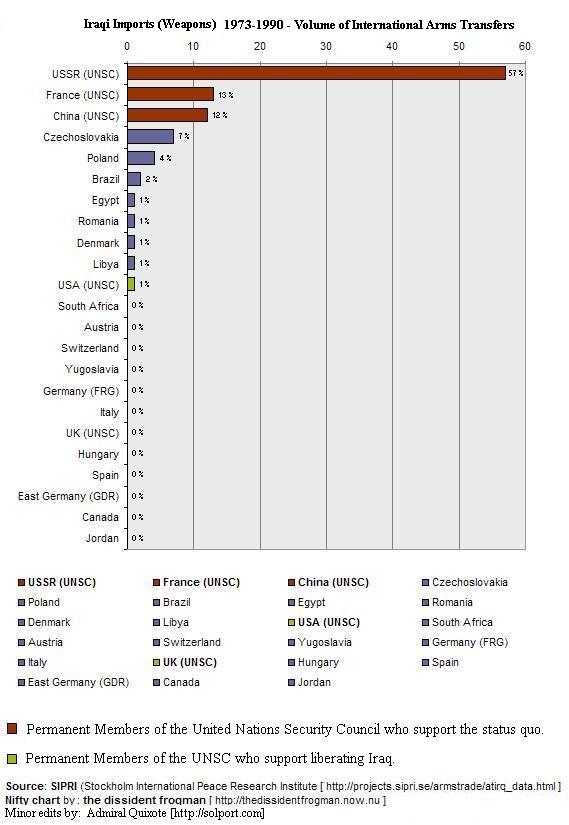
Who armed Saddam? The short answer is that, contrary to standard mythology, it wasn't the US. (For a quick summary of some relevant information, see the graph below.) A slightly more detailed answer follows.

=> It is widely believed that Saddam Hussein was a client of the US, which armed and supported him during the whole period of his rule (and, in some versions of the story, even helped put him in power in the first place), until the US turned on him after 1991. But almost all these commonly held beliefs happen to be either incorrect or, in cases where they have a grain of truth, extremely misleading. These myths are too numerous and tangled to deal with them all at once, but here are a few basic reality checks.

The US did not bring the Iraqi Ba'ath Party to power in 1968, nor did it play a significant role in maintaining them in power until they had been in control for a decade and a half. (Frankly, the US probably played a bigger role in helping to bring Nasser to power in Egypt back in the 1950s, though that romance didn't last long.) The Iraqi Ba'ath Party was an indigenous fascist movement--the closest equivalent in the Arab world to the classic European fascist movements of the inter-war period, a model on which Ba'athist ideology drew quite explicitly in an era when fascism had tremendous world-wide prestige and looked to many people like the wave of the future. The other major branch of the Ba'ath Party, of course, is the one that has been ruling Syria for almost 3 decades now. But the Assad regime in Syria, for all its repression and brutality, has really been closer to a standard military dictatorship than the pre-2003 Iraqi Ba'ath regime.

The Iraqi Ba'athists came to power in the course of brutal conflicts with other Iraqi political forces--including the once-significant Iraqi Communist Party, which they crushed and whose members they slaughtered or drove into exile (another echo of the Ba'ath Party's inter-war European models). Saddam Hussein did not start out as the titular head of either the Party or the regime, but he gained increasingly effective control behind the scenes, and then in 1979 he had himself formally declared President and murdered his remaining opponents within the Party (some of them personally, most in a bloody purge).

The Ba'ath regime was strongly anti-American, so it's not surprising that--despite the unfortunate fate of the Iraqi Communist Party--it was primarily a client of the Soviet Union (not the US), and this relationship continued up until the moment when the Soviet Union collapsed. The other major patron of Saddam Hussein & his regime was France (which, among other things, was the main supplier for his nuclear-weapons program as far back as the early 1980s). Of course, the Iraqi Ba'ath regime was never a simple tool of any of these patrons. It had its own agenda, and it played off its patrons--as well as other supporters--against each other when that suited its purposes.

Yes, I know there is a pre-fabricated geopolitical morality play into which Saddam Hussein is supposed to fit, playing the role of just one more pro-American dictator, so that everything he ever did is really (you guessed it) the fault of the US. The complication is that in real life, he doesn't fit into this scenario, and no amount of mindless parroting of the standard clichés will make them less erroneous. This is ideological mystification, not analysis or serious argument.

=> The relationship between the US and the Iraqi Ba'ath regime did shift during the Iran/Irag war of 1980-1988, especially after 1982. And at times during this period, the US did behave quite shamefully (along with just about everyone else).

As readers will recall, the Iran/Iraq war began with Saddam Hussein's invasion of Iran in 1980--one of his string of catastrophic miscalculations. Two years later, the Iranians had pulled themselves together and expelled the Iraqis from the parts of Iranian territory they occupied. Then 6 more years of war followed, with hundreds of thousands killed, massive use of poison gas by the Iraqis, the indiscriminate shelling of cities and other atrocities on both sides, etc. The fact that the war continued that long was essentially the decision of the Ayatollah Khomeini. Saddam Hussein was now desperate to make peace, but Khomeini was determined to overthrow him, and refused to consider even negotiating until Saddam was removed from power.

During most of those 6 years, the Iraqi regime seemed to be teetering constantly on the edge of catastrophe. By this time, the Iranians had so thoroughly terrified everyone else that just about the whole world more or less actively backed Saddam Hussein (and let him get away with anything, including massive war crimes and other crimes against humanity). I mean almost everybody--the Soviet Union, the EU countries, the Arab world (with the exception of Syria & Libya), India, China, etc., etc. Turning a blind eye to Saddam Hussein's crimes was justified in the name of "realism" (by the same people who later condemned the 2003 Iraq war on the same grounds), but it turned out to be closer to what C. Wright Mills used to call "crackpot realism."

After news of the 1988 "Anfal" genocide in Iraqi Kurdistan got out, the US Senate, to its great credit, unanimously passed the Prevention of Genocide Act condemning the Anfal genocide and threatening sanctions. (This was deep-sixed by the Reagan administration, which blocked passage in the House.) The Arab world responded with outrage (to the criticism of Saddam Hussein, not to the genocide), and the Arab League expressed "total solidarity" with Saddam Hussein's Iraq.

=> Meanwhile, during the period from 1968-1991, where did the weapons and other military supplies for Ba'athist Iraq come from? The figures below, from the Stockholm International Peace Research Institute (SIPRI), cover only "conventional" arms and only the period from 1973-1990. But they convey the basic picture clearly enough.

Saddam's weapons came overwhelmingly from the Soviet Union & other Soviet Bloc countries (69% during this period), followed by France (13%) and China (12%) and a string of smaller suppliers. (For example, according to a 1984 SIPRI report, "During 1982-83, Iraq accounted for 40% of total French arms exports.") The figure for the US is 1%.

When it comes to Saddam Hussein's nuclear, chemical, and biological weapons programs, the picture is a little more complex. It seems clear that France was far and away the biggest supplier for the nuclear weapons program. Supplies for Saddam Hussein's chemical and biological weapons (which included dual-use materials also suitable for making agricultural fertilizer, pesticides, medicines, etc.) were bought from a variety of sources, which seem to have been primarily western European or Russian and primarily private rather than governmental. For one discussion of the role played by German firms, for example, in supplying Saddam Hussein's poison-gas and biological-weapons programs, see The leading role of Germany in arming Iraq:
Chemical agents? Biological agents? Machine tools and parts and materials for uranium enrichment and missile production? You name them and the Germans delivered them - and not only that: they supplied the plants and know-how for Iraq to make its own "pesticides" ("to protect the date harvest"), "vaccines" ("to eradicate smallpox and other contagious diseases"), and "x-ray machines".
It would be wrong to think that German firms were alone in doing all this. But once again, the US role was relatively minor.

(For further information, see the database on Iraq's Suppliers compiled by Iraq Watch.)

=> The US did provide other significant forms of support for Iraq during the closing years of the Iran/Iraq war, economic and diplomatic and otherwise.  As the war ground on, the US also began to provide Iraq with satellite and intelligence information of some military value, and toward the very end US naval forces protecting oil tankers in the Gulf occasionally clashed with Iranian naval forces (and on one terrible occasion mistakenly shot down an Iranian civilian airliner).  Considering all that would require a longer discussion.  For the moment, suffice it to say that the catch-phrase that the US "armed Saddam" is simply wrong, no matter how many times it is mindlessley repeated.

Yours for reality-based discourse,
Jeff Weintraub

=========================
(Figures from the Stockholm International Peace Research Institute - SIPRI)

The Command Post
March 31, 2003
The Facts Stand Alone


update: Given the amount of email I’ve received on this post, I’ve updated the picture to more clearly show that the data only goes to 1990. This is why you may see news information about weapons provided by firms from other countries (e.g., Jordan, Germany, etc.) that is not captured here. The Stockholm International Peace Research Institute (SIPRI) only felt confident in their information up to 1990. After Saddam invaded Kuwait, any and all arm trades to Iraq would be a violation of the United Nation sanctions. Obviously, these sellers did everything possible to hide these sales and SIPRI certainly does not have all of this information.

In addition, SIPRI does not try to show which weapons are more effective. SIPRI calculated the dollar amount of all weapon transfers (in 1990 dollars). So in terms of dollar value, Russia was responsible for 57% of all weapon sales to Iraq between 1973 and 1990.

Posted By Admiral Quixote (Solport) at March 31, 2003 04:34 PM | TrackBack

Thursday, January 13, 2005

Juan Cole et al. - "TheThird Baath Coup?"

What is the Iraqi "insurgency" about? Here is an interesting recent analysis by the scholar of Islam Juan Cole (currently President-Elect of the Middle Eastern Studies Association), whose political commentary on his "Informed Comment" weblog is, indeed, well informed and almost always acute, whether or not one fully agrees with it.

It has long been clear that the heart of the "insurgency" is a loose collection of fascist thugs left over from the Baath regime; Islamist fanatics; Sunni irredentists unwilling to give up their historic status as the dominant minority in Iraq; and foreign jihadists. (This is all quite distinct from the off-and-on Shiite insurgency linked to Muqtada al-Sadr, whose profile is very different. But the violence and disruption in Iraq come overwhelmingly from the Sunni insurgency, and at all events the Sadrists seem to be mostly quiet and relatively marginalized for the moment.)

What is distinctive about Cole's argument here is his suggestion that the Baathist element in the insurgency outweighs all the others in importance. My impression is that this underplays the significance of the Islamists in the overall mix. But other people, including some Iraqis (and, interestingly enough, Scott Ritter), have also argued that Baathist secret-police and military networks play a crucial role in organizing and driving the Sunni insurgency.

(Some analyses by Iraqis that I've read recently--see after Cole's piece, below--have suggested that this could help explain why insurgent attacks in Iraqi Kurdistan have been minimal, aside from some very occasional atrocities. It's not enough to say that they have no support there, because they're able to carry out spectacular attacks in the Shiite south of Iraq, where they also have almost no popular support. Instead, the key factor is that Iraqi Kurdistan is the one part of the country where underground Baathist networks have been totally dismantled for a long time. Could be.)

These issues are not easy to resolve right now, even for people more knowledgeable about Iraq than I am. But the following practical conclusions that Cole draws are definitely on target. Simply put, for the US to simply abandon Iraq right now would be neither a realistic nor a morally defensible solution.

The Baath has been systematically killing members of the new political class. This is visible at the provincial level. The governors of Diyala and Baghdad provinces have recently been killed. The killing and kidnapping of members of the provincial governing councils go virtually unremarked in the US press but are legion. A female member of the Salahuddin GC was kidnapped and killed recently. The police chiefs of many cities have been killed or kidnapped, or members of their family have, such that many more have just resigned, often along with dozens of their men. The US is powerless to stop this campaign of assassination.

And this is my problem with the idea of just having the US suddenly withdraw its military from Iraq. What is to stop the neo-Baath from just killing Grand Ayatollah Sistani, Abdul Aziz al-Hakim, Ibrahim Jaafari, Iyad Allawi (who is rumored not to sleep in the same bed twice), etc., all the members of the provincial councils and the new parliament, and then making a military coup that brings the party and its Sunni patronage networks back to power?

I think this coup would look more like the failed 1963 effort than like 1968, and has the potential to roil the country and the region for decades. The tanks and helicopter gunships and chemical weapons that the Sunni Arab minority regime used to put down the other groups are gone, and it is not clear that car bombs, Kalashnikovs and sniping could substitute for them. They can probably take the Green Zone and the television stations if the US abruptly withdraws, but could they really put down the South effectively again?

For this reason, I fear I think the US is stuck in Iraq. Sistani clearly fears a Sunni Arab coup, as well, and this is one reason he has not acted forcefully to end the military occupation, which he deeply dislikes.

--Jeff Weintraub

======================

Juan Cole ("Informed Comment")
January 13, 2005

The Third Baath Coup?

If, as I have argued, the Baathists along with some Salafi (Sunni fundamentalist) allies are behind the guerrilla war, what do they want? They want to drive the Americans out of Iraq and make a third Baath coup, putting the Shiite genie back in its bottle and restoring Sunni Arab primacy.

A third Baath coup is no more inherently implausible than the first two. The Baathists probably have access to some 250,000 tons of munitions which are still missing. They know how to use them, and have been the managerial class, and many are Iran-Iraq War and Gulf War veterans with substantial military experience.

As long-time readers know, I have long held a position similar to that enunciated by former weapons inspector Scott Ritter's assessment that the lion's share of violence in Iraq is the work of Baathist military intelligence and military gone underground, and that the tendency to blame everything on Zarqawi and a handful of foreigners is a propaganda move that suits both the Baath mukhabarat and the Bush administration. AP correspondent in Baghdad, Borzou Daragahi, makes much the same argument.

Only 6 percent of the fighters captured at Fallujah were foreigners, and Fallujah anyway had long had a high foreign-born population, being a frontier and desert port. By Baath I don't necessarily mean committed ideological Baathists, but the party was how they were formed politically, along with networks of clientelage based in the Sunni Arab heartland.

The Baath has been systematically killing members of the new political class. This is visible at the provincial level. The governors of Diyala and Baghdad provinces have recently been killed. The killing and kidnapping of members of the provincial governing councils go virtually unremarked in the US press but are legion. A female member of the Salahuddin GC was kidnapped and killed recently. The police chiefs of many cities have been killed or kidnapped, or members of their family have, such that many more have just resigned, often along with dozens of their men. The US is powerless to stop this campaign of assassination.

And this is my problem with the idea of just having the US suddenly withdraw its military from Iraq. What is to stop the neo-Baath from just killing Grand Ayatollah Sistani, Abdul Aziz al-Hakim, Ibrahim Jaafari, Iyad Allawi (who is rumored not to sleep in the same bed twice), etc., all the members of the provincial councils and the new parliament, and then making a military coup that brings the party and its Sunni patronage networks back to power?

I think this coup would look more like the failed 1963 effort than like 1968, and has the potential to roil the country and the region for decades. The tanks and helicopter gunships and chemical weapons that the Sunni Arab minority regime used to put down the other groups are gone, and it is not clear that car bombs, Kalashnikovs and sniping could substitute for them. They can probably take the Green Zone and the television stations if the US abruptly withdraws, but could they really put down the South effectively again?

For this reason, I fear I think the US is stuck in Iraq. Sistani clearly fears a Sunni Arab coup, as well, and this is one reason he has not acted forcefully to end the military occupation, which he deeply dislikes.

Is the Neo-Baath Coup scenario one that the US could live with?

posted by Juan @ 1/13/2005 06:19:23 AM


=============================

-------------------------------------------
http://www.iprospect.org.uk/na19nov.html
-------------------------------------------
Iraqi Prospect Organization
November 19, 2004

News Analysis

By Yasser Alaskary & Sama Hadad
November 19, 2004

Solving Iraq's Security Riddle

There is growing evidence that the core of the insurgency is almost purely Baathist:

1. The Fallujah experience

Prior to the operation in Fallujah, it was generally believed that the majority of the insurgent leadership were foreign Arab Salafi extremists. However, this is now in question. Arab Salafi extremists, like those associated with the militant Abo Musab Al-Zarqawi, explicitly seek out 'martyrdom' as their victory. On the other hand, Baathists have no interest in being killed and every interest in defeating the new Iraqi government and wearing out the US-led coalition into withdrawal. The sheer ease with which US and Iraqi forces overran Fallujah indicates that most insurgents had left the city. Such a move is not characteristic of Salafi extremists who would have relished a final battle against their perceived enemy. It is, however, characteristic of a Baathist-led insurgency that does not want to face the US at its time of choosing but would rather slip away and attack at a time of their choosing.

2. Baathists were not defeated

Policy makers would do well to remember that whilst the Baathist regime lost the war, it was never defeated. The core of the Baath Party, who made up the dozens of security organizations and local networks trusted by Saddam Hussein, were concentrated in central Iraq. While Saddam's regime threw thousands of foot-soldiers to the south to slow down the advancement of the coalition, the Baathists never fought once the coalition reached central Iraq. In the city of Ramadi, a bastion for the Baath Party, not a single bullet was fired - the Baathists simply melted away amongst the civilian population. The failure of the coalition governments to recognize this danger has allowed these Baathists to lead the insurgency: planning, organizing, and coordinating terrorist activity while using the same 'Islamic' propaganda as Saddam did to lure in militants to carry out the suicide bombings and their other dirty work.

3. The Kurdish phenomenon

Furthermore, every Iraqi city has suffered numerous suicide bombings, explosions and terrorist acts, except for those located in the former Kurdish safe-haven. A foreign terrorist does not have any preference as to where he carries out his attack as he is foreign to all regions of Iraq - so why then is there such a geographic phenomenon? Some argue that this is because the foreign terrorists cannot find any sanctuary in the former safe-haven region, but this is a flawed assumption. There are Salafi Kurdish groups based in these regions and they would be more than willing to provide automatic shelter and help to their ideological brothers. In contrast, external Arab terrorist are very unlikely to find any sanctuary in many Shia cities yet such cities have not been spared from insurgent activity. Therefore, the presumption that the insurgency is at its core made up of foreign Arab Salafi extremists cannot explain the discrepancy between the former Kurdish safe-haven and the rest of Iraq. However, this phenomenon can be easily explained if we assume the insurgency is Baathist at its core. The Baath regime of Saddam have been excluded from the Kurdish safe-haven since 1991, they no longer have a working knowledge of the area, they lack the Baath network which exists in the rest of Iraq, and are therefore unable to carry out any operations in this region.

Policy Strategy

With the evidence pointing to a Baathist-led insurgency, most likely comprising of former members of Saddam's security services and local Baathist leaders concentrated in what is called the Sunni triangle (which would be more appropriately named the Baathist triangle), there must be a clear strategy to finally defeat the Baathists if security is to be restored. This can be done by:

  1. Stopping the process of re-Baathification. Why it should come as a surprise that the new Iraqi security forces continue to be 'infiltrated' when Baathists are actively recruited and reinstated in top-level positions is staggering. Building Iraq's security around the people who wish to destroy it is sheer stupidity and dangerously incompetent. Furthermore, this process has only served to alienate those who suffered under the Baath regime, especially amongst the Shia and Kurds, and has done nothing to pacify or appease non-Baathist Sunnis.
  2. Actively rounding up any 'former' Baathists associated with Saddam's security forces and local Baathist ring-leaders. For the first few months after the war, when most Baathists had fled their neighbourhoods and were in hiding, the security situation was remarkably calm. When they found they were not being hunted, they grew in confidence and began to launch attacks. There has been a sustained upsurge in terrorist activity since then, dramatically increasing after re-Baathification was launched in the summer. We should have them on the run, not giving them the freedom and time to plan and organize more terror. They should be living in fear of being arrested, not inflicting fear on the people of Iraq.
  3. Reinvigorate the process of de-Baathification. The Baath Party has not been defeated by the war as many of its key members are still in positions of power, helping their 'comrades' on the outside (see the IPO's November 1, 2004 analysis for examples of this).

Before an enemy can be defeated, it must be identified. The US-led coalition and the Interim Iraqi Government can continue to convince themselves that the insurgency is not Baathist at its core; they can continue with the failed process of re-Baathification. However, the Fallujah phenomenon will be repeated again and again and Iraq's security will spiral even more out of control and ultimately innocent Iraqis will pay the price.

=====================

openDemocracy
November 18, 2004

Fallujah’s lesson for Iraq
Sama Hadad
18 - 11 - 2004


The United States-led assault on Fallujah signals the political failure of the attempt to stabilise Iraq by re-empowering supporters of Saddam’s Ba’ath party and the Sunni elite it represents, says Sama Hadad.

At an enormous human and physical cost, American and new Iraqi forces are in almost complete control of the insurgent stronghold city of Fallujah. But this operation represents also the political failure of the strategy adopted by the United States in Iraq in recent months: “re-Ba’athification”.

After the fall of Saddam in April 2003, the interim Iraqi prime minister Iyad Allawi and his supporters in Washington fiercely opposed de-Ba’athification (the systematic removal of Saddam’s Ba’ath party supporters from the higher reaches of the state and military). The logic was plain: Allawi’s Iraqi National Accord draws its support from former Ba’athists and Iraq’s Sunni elite.

A wrong turning

In April 2004, a year after regime change, mounting international pressure over civilian casualties during the United States’s military operations around Fallujah led Washington to abandon the de-Ba’athification policy it had implemented after the overthrow of Saddam. Instead, the then-governing body, the Coalition Provisional Authority (CPA), created a “Fallujah Brigade” led by former Ba’athists with military experience of Saddam’s wars against his own people.

This signaled a wave of further appointments of high-ranking Ba’athists to top security service and government posts – just as Iyad Allawi had been advocating. Their thinking was that appointing former Sunni elite and Ba’athists to positions of power would kill two birds with one stone: making use of their “expertise” as well as appeasing the Sunni population.

Jasim Muhammed Salih was appointed commander of the Fallujah Brigade, but mounting opposition over his past role as chief of staff of a Republican Guard brigade who participated in the bloody suppression of the 1991 Shi’a uprising led to his removal only days later. The brigade command was then handed to a former Saddam intelligence officer, Mohammed Abdul Latif. As insurgency activity unsurprisingly soared once more in Fallujah, coalition forces eventually found the Fallujah Brigade to be effectively working alongside them by day and planning and executing insurgency activity by night. In September 2004, the Fallujah Brigade was quietly disbanded.

A dangerous game

The saga of the Fallujah Brigade symbolises the incompetence as well as the injustice of “re-Baathification”, and highlights the dangerous repercussions of this policy. Allawi’s aggressive restoration of Ba’ath elements to the government and security services has paved the way for people like Amer al-Hashimi to be appointed chief of staff of Iraq’s new army.

Al-Hashimi, a former major-general in Saddam’s army (and Salafist), was fired in August after being exposed for supplying Salafi insurgents with intelligence and promoting them to high ranks in the new Iraqi army. Al-Hashimi’s replacement was Mohammed Abdul-Qadr, former Ba’athist governor of Mosul and deputy chief of staff under Saddam; but even more worrying is that al-Hashimi himself was later appointed an advisor to the ministry of defence.

Allawi’s policy was reflected also in the appointment of Talib al-Lahibi as commander of the new Iraqi National Guard for the province of Diyala. Al-Lahibi, a former Saddam officer, was arrested in September when it came to light he was leading – rather than attempting to suppress – the insurgency in the province.

But Allawi’s gravest re-Ba’athification blunder was his appointment of Yousef Khalaf Mahmood as head of security for the Iraqi interim cabinet. Mahmood was arrested at the end of October after the discovery that he was working with the insurgents and had supplied them with the names and addresses of every government official and ministerial member of staff – six of whom (including family members) have been murdered in their homes. This blunder will keep insurgents busy for months to come.

It is clear that, under re-Ba’athification, the very people Iraq is relying upon for its rebuilding and democratisation are now sitting targets.

The reinstatement of members of the Sunni elite and former Ba’athists ensures that leadership of the new Iraqi security forces is once again Sunni-dominated, as it had been for four decades under Saddam. The policy is exacerbating Iraq’s insecurity – and at several levels: in just one Iraqi unit in the latest Fallujah operation, 100 Sunni soldiers deserted their posts on the way to the city.

Most commentators and political advisors now correctly identify the need for a political solution to partner the Fallujah military operation. But in advocating the same policy that was adopted seven months ago – increased Sunni and “clean” Ba’athist representation in order to propitiate the Sunni population – is misconceived, as this will only guarantee continued infiltrations, desertions, and insurgency.

Allawi’s policy of re-Ba’athification and Sunni dominance is dangerous for Iraq’s future. The reality on the ground makes a change of plan essential. De-Ba’athification coupled with Shi’a leadership of the new security forces is the only long-term policy that makes possible both a defeat of the insurgency and Iraq’s movement towards democracy.

Monday, June 10, 2013

Turkey's summer of discontent – Some images and analyses

Last Thursday I mused about some echoes of the spirit of 1968 in the current protest wave in Turkey.  A music video forwarded from Istanbul by Claire Berlinski conveys some more of those echoes, along with some striking images of what's been happening in Istanbul.


(More photos here.)

=>  But it's a safe bet that  this video captures only one dimension of the meaning of Turkey's June Days.  This protest wave has clearly brought together a wide range of underlying discontents in one grand eruption.  It's worth reading two analyses, one by Berlinski and the other by Juan Cole, each of which highlight elements which I think have been missed or, at least, insufficiently explored in most American discussions.

Here are some highlights from Berlinski's piece on June 3, "Erdoğan Over the Edge":
The story began when the government in Ankara decided that Gezi Park, in the center of Istanbul, should be demolished and replaced by a shopping mall. Now, Gezi Park is hardly the Jardins de Luxembourg. It’s a shabby rat trap that you wouldn’t walk through alone at night, and you’re more apt to find used condoms on its lawns than daisies and cowslips. But it is, all the same, one of the last remaining spaces with trees in the neighborhood.

Over the past decade, Istanbul has seen a massive construction boom. Lovely old buildings have been razed by the hundreds and replaced by shopping malls. Until this week, I would have said that while this transformation was not to my taste, it was very much to the liking of the people who live here: after all, they were certainly doing a lot of shopping. Apparently, I was wrong.

When the company building the shopping mall began cutting down trees, protesters occupied the park—peacefully. But in truth, these protests weren’t about the park or even about the shopping malls. They were about a people exhausted by Istanbul’s uncontrolled growth; by its relentless traffic; by the incessant noise (especially that of construction); by massive immigration from the countryside; by predatory construction companies—widely and for good reason believed to be in bed with the government—which have, over the past decade, destroyed a great deal of the city’s loveliness and cultural heritage. But most of all, they are about a nation’s fury with Prime Minister Recep Tayyip Erdoğan’s growing authoritarianism, symbolized by Istanbul’s omnipresent police, the phalanxes of so-called Robocops. They are so notoriously trigger-happy that journalists on Twitter post a daily tear-gas report.

Of late, almost every sector of the electorate has felt unease about one part or another of Erdoğan’s agenda. Restrictive new alcohol legislation, rammed through parliament, as usual, with contempt for the minority opposition, has prompted outrage; the so-called peace process with the PKK, which no one understands, has caused great unease. Anxiety is growing as well, not only about press censorship, but also about the prosecution of those who insult government officials or “Islamic values” on social media. There is outrage about the bombing in Reyhanlı that left 52 Turks dead and which appears to have been attributable to a series of inexcusable police and intelligence blunders (but no one knows, and no one believes what the press writes); there is fear of war with Syria; there is concern about strange reports that al-Nusra, a Syrian militant group affiliated with al-Qaida, has been cooking up Sarin gas in Adana, five miles east of the United States’ Incirlik Air Base; and there is deep skepticism about Erdoğan’s plans for grandiose construction projects—such as a third airport, a second Bosphorus canal, and a gigantesque mega-mosque intended to exceed in size every mosque left behind by his Ottoman predecessors. The thing will dominate Istanbul’s already-martyred skyline, and replace yet another pleasant and leafy park.

The recent announcement that a new bridge over the Bosphorus was to be named after Sultan Selim the Grim, slayer of the Alevis—a substantial and beleaguered Turkish religious minority—didn’t help matters. Nor did it soothe fears when a minor AKP official from the sticks wrote on Twitter that “My blood boils when spineless psychopaths pretending to be atheists swear at my religion. These people, who have been raped, should be annihilated.” Two weeks ago in Ankara, a disembodied voice on the subway, having apparently espied them by means of a security camera, denounced a couple for kissing. The voice demanded that they “act in accordance with moral rules.” In return, incensed Ankara lovers staged kissing protests: as the couples shyly smooched outside the subway station, a group of young men confronted them, chanting “Allahu Akbar!” It was reported but not confirmed that one of the kissers was stabbed; but given the mood of hysteria here right now, it would be unwise to believe every rumor one hears.

Erdoğan, it seems, severely underestimated the degree of his subjects’ displeasure, confident that God, a strong economy, and a weak opposition were all he needed to ensure his hegemony. He brusquely dismissed the tree protesters’ concerns: “We’ve made our decision, and we will do as we have decided.” An AKP parliamentarian then unwisely announced that some young people "are in need of gas.”

So the Robocops once again used pepper spray and water cannon against the protesters. A photographer captured them spraying tear gas directly into the face of a vulnerable, middle-aged woman in a pretty red dress. The photo went viral and enraged the public: she was clearly no hooligan. As one conservative journalist noted, she looked “decent.”

Rather than dispersing for good, the protesters returned—and more gathered to support them. This wasn’t supposed to happen. The police panicked. At dawn, they attacked with pronounced violence, injuring not only students, but also journalists and opposition members of parliament who had come to show their support. They also seriously wounded the photographer who took the “red dress” photo, which was probably not a coincidence. Nor was it likely a coincidence that they fired a tear-gas canister “at close range” at the head of journalist Ahmet Şık, best known for writing about the infiltration and corruption of Turkey’s police forces by the followers of the Turkish imam Fethullah Gülen. For this, Şık was jailed as a “coup-plotter.” This time, he wound up in the hospital, though he is expected to recover. [....]

If the protests keep escalating and the crackdown intensifies, it’s hard to see how this can end well. Best case: the protests will spook the prime minister and give him a much-needed dose of humility. Worst case: The protests will spook the prime minister and leave him even more paranoid and vengeful.

Unfortunately, the early signs point toward the second scenario. [....]
Juan Cole's initial take on the Turkish protest wave came in two posts, on June 4 and June 7.  Here are some highlights from his June 4 post:
The news that Turkey’s Public Workers Unions Confederation (KESK), representing coalition of 11 trade unions with 250,000 members has now announced a two-day general strike in sympathy with the protesters signals the entry of an element of class conflict into the movement. The unions in Turkey are weak, having been destroyed by the secular right wing military dictatorship of the 1980s, which had the side effect of also destroying the Turkish Left as a viable political bloc. The ruling center-right Justice and Development Party probably benefited in implementing its pro-market policies from the weakness of unions. The unions and the remains of the Left may see an opportunity for revival.

Erdogan has blamed everyone but himself for the public discontent, decrying the ‘lies’ spread on Twitter, hinting darkly that the opposition party, the secular Republican People’s Party [CHP] had conspired to provoke the protests, and now even saying that the demonstrators are ‘linked to terrorists.’

Erdogan’s theory of what is happening shows an unflattering streak of paranoia and arrogance, and, worse, it is clearly wrong. If a prime minister cannot understand what is happening in his own country, it is a very bad sign. [....]
And here's a snippet from Cole's follow-up post on June 7:
Bahar Leventoglu, Assistant Professor of Political Science and Economics at Duke and a native of Turkey, told senior editor at Duke’s Office of News & Communications Steve Hartsoe that she “does not see the prime minister recovering from this as easily as Erdoğan expects.”

“Erdoğan has been the most popular prime minister in the history of modern Turkey,” she said. “His understanding of democracy is about ballot power. As his ballot power increased, he started to get more and more authoritarian thinking that more and more people gave him the mandate to do anything he wanted. Over time, the Erdoğan that was quite a reformer prime minister in his first term disappeared, and we got this angry, know-it-all, almost Putin-esque prime minister that we did not know as much before.”

[JW:  They just noticed "this angry, know-it-all, almost Putin-esque" Erdogan now?  Who is the guy I've been reading about all these years?]

"A lot of people now see Erdoğan’s policies as a ‘cultural war’ against their lifestyles, and see the government’s so-called ‘Taksim project’ as an extension of this cultural war. Taksim (where the protests were held) is a neighborhood whose lifestyle Erdoğan dislikes, with nightlife and drinking, and is not good for the ‘religious generations’ Erdoğan wants to raise.”

Leventoglu continued: “Erdogan also has no tolerance for criticism. He believes that he knows what is good and what is bad for citizens of Turkey, and so we have to obey him as if we are teenagers being disciplined by dad. I’m sure he was taken by surprise by the protests against the government, as Turkey does not have a long history of this. But times are changing, and Erdogan is behind the times in this one.”
Maybe. But at all events, Berlinski's piece and these two pieces by Cole are worth reading in full,

—Jeff Weintraub